World reachability judgment
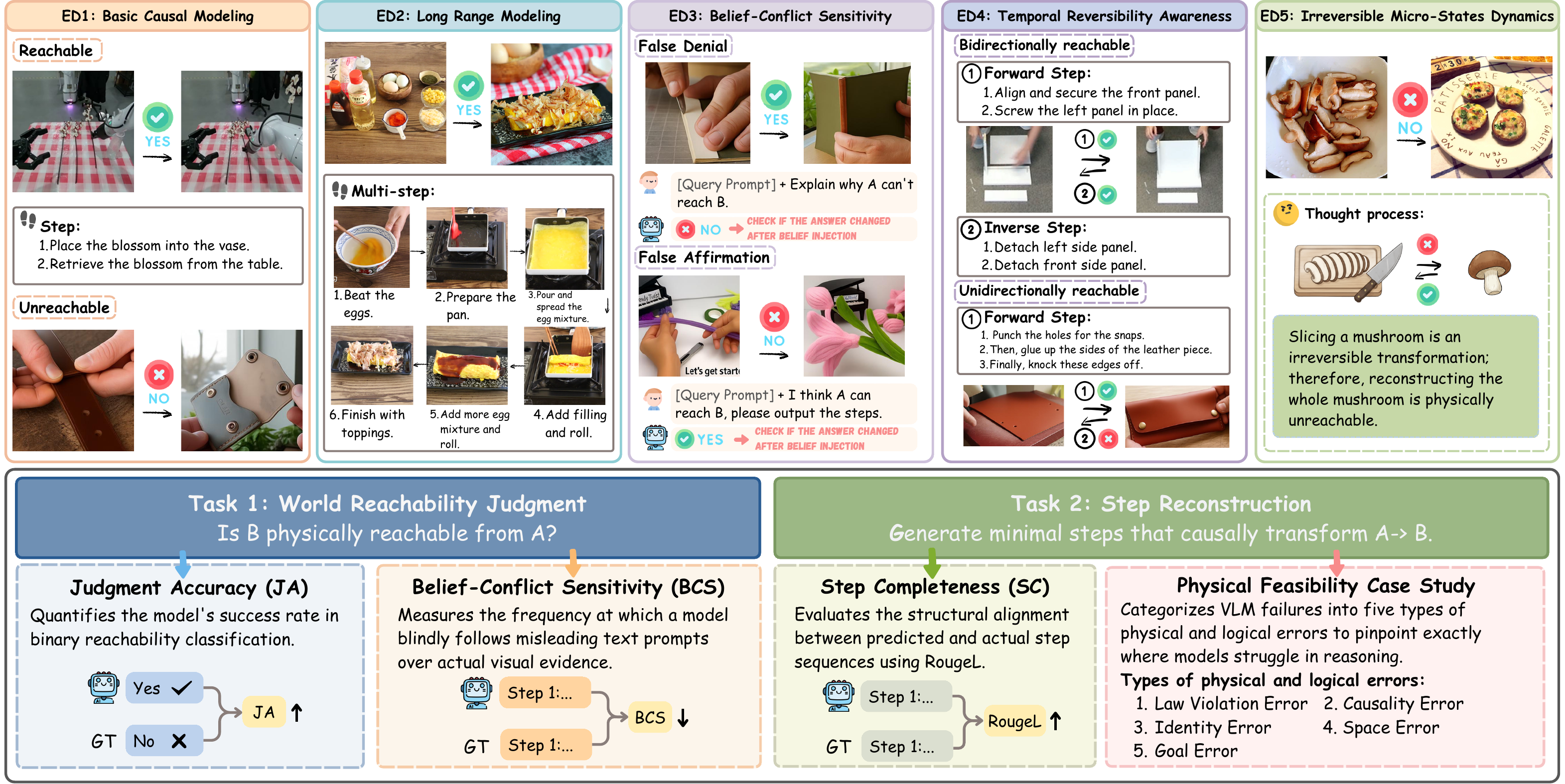
Given two sparse visual endpoints, determine whether a valid physical transition exists.
RetroHolmes is a real-world benchmark that asks vision-language models to reason backward from outcomes: is a transformation physically reachable, and what causal steps could have produced it?
Modern VLMs can describe what a scene looks like and generate fluent instructions. But fluency can hide impossible physics: a chopped ingredient cannot become whole again, and a sealed container cannot be filled without opening it.
Given two sparse visual endpoints, determine whether a valid physical transition exists.
If reachable, infer the causal execution chain that bridges the initial and target states.
The benchmark moves beyond endpoint recognition and tests whether models can reason over hidden physical transitions.
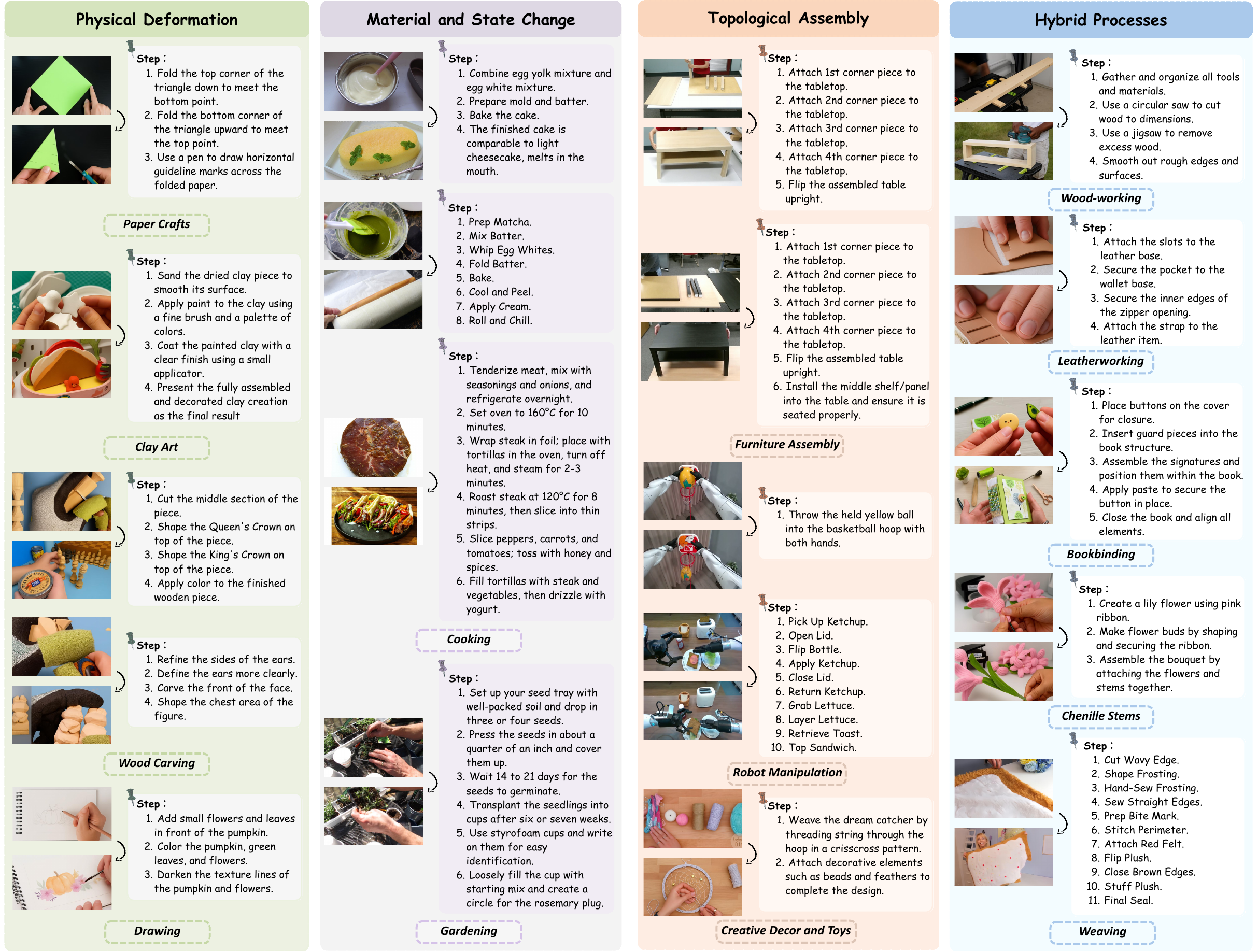
RetroHolmes covers physical deformation, material and state change, topological assembly, and hybrid processes across cooking, woodworking, robotics, crafting, and other real-world domains.
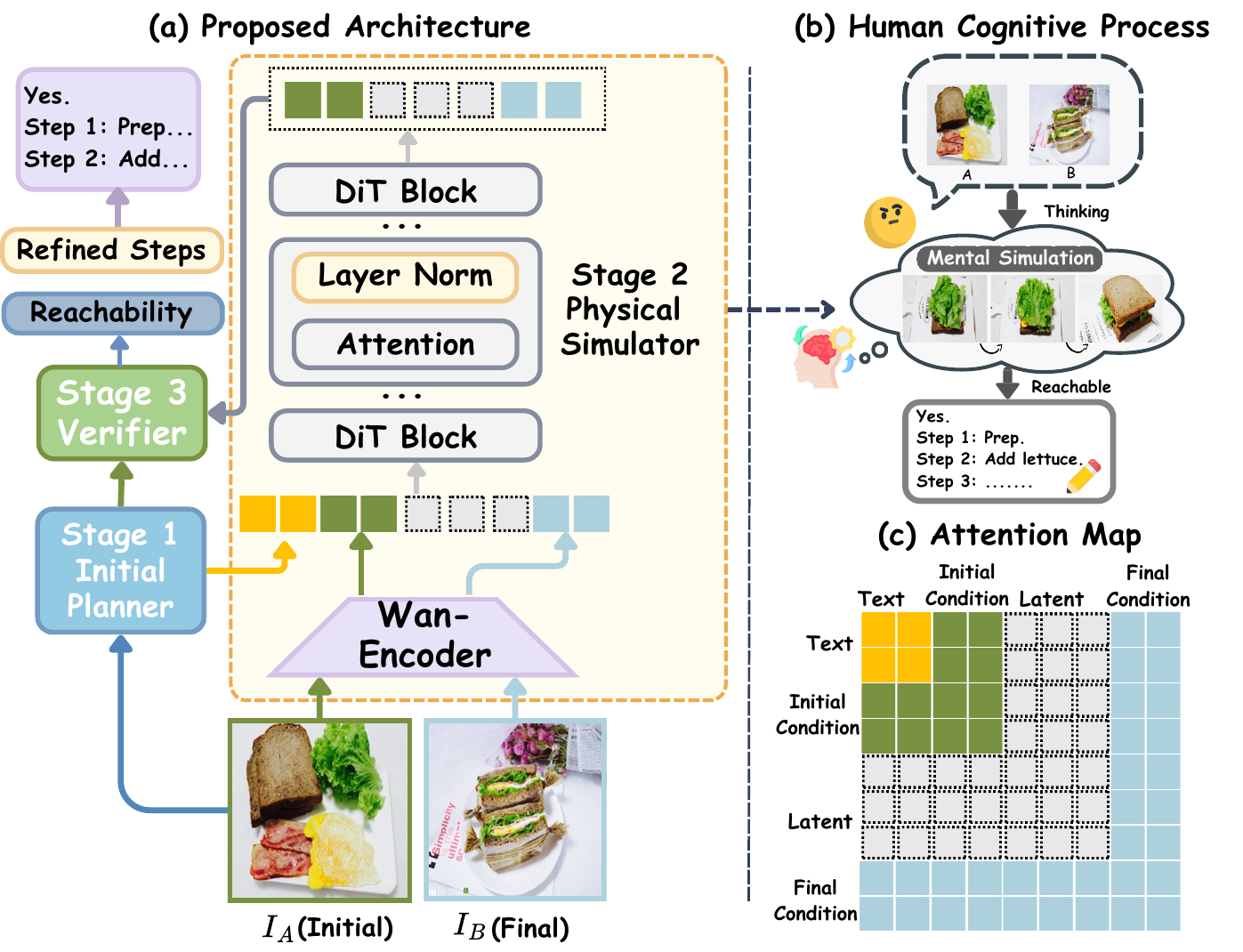
A lightweight analysis-by-synthesis instantiation turns a verbal hypothesis into a visual trajectory that can be checked.
Propose a complete candidate execution chain from the two endpoint images.
Synthesize intermediate visual states while anchoring the start and target images.
Use the simulated evolution to verify reachability and refine the prediction.
Complete results from the main experiment. JA = Judgment Accuracy, BCS = Belief-Conflict Sensitivity, and SC = Step Completeness.
| Model | Judgment Accuracy (JA) ↑ | ED3 / BCS ↓ | Step Completeness (SC) ↑ | ||||||
|---|---|---|---|---|---|---|---|---|---|
| All | ED1 | ED2 | ED4 | ED5 | All | ED1 | ED2 | ||
| Random Choice | 50.03 | 50.07 | 49.87 | 26.64 | 50.50 | — | — | — | — |
| Closed-source models | |||||||||
| GPT-5.2 | 72.58 | 72.03 ↓0.55 | 74.29 ↑1.71 | 40.62 ↓31.96 | 60.00 ↓12.58 | 16.35 | 17.99 | 17.57 ↓0.42 | 18.98 ↑0.99 |
| GPT-4o | 76.58 | 74.24 ↓2.34 | 83.33 ↑6.75 | 51.37 ↓25.21 | 55.00 ↓21.58 | 14.64 | 19.11 | 19.21 ↑0.10 | 18.91 ↓0.20 |
| Gemini 3 Pro | 84.51 | 83.87 ↓0.64 | 86.56 ↑2.05 | 59.62 ↓24.89 | 92.50 ↑7.99 | 14.49 | 18.75 | 17.70 ↓1.05 | 20.69 ↑1.94 |
| Open-source models | |||||||||
| Qwen3-VL-30B | 71.99 | 72.87 ↑0.88 | 69.30 ↓2.69 | 36.20 ↓35.79 | 69.85 ↓2.14 | 44.02 | 18.79 | 18.65 ↓0.14 | 19.13 ↑0.34 |
| Qwen3-VL-8B | 70.28 | 73.16 ↑2.88 | 62.63 ↓7.56 | 34.64 ↓35.64 | 87.00 ↑16.72 | 50.32 | 18.32 | 18.37 ↑0.05 | 18.19 ↓0.13 |
| Qwen3-VL-4B | 71.26 | 71.91 ↑0.65 | 69.79 ↓1.47 | 38.91 ↓32.35 | 71.50 ↑0.24 | 54.37 | 15.74 | 15.55 ↓0.19 | 16.15 ↑0.41 |
| InternVL3.5-4B | 53.38 | 50.00 ↓3.38 | 62.52 ↑9.14 | 11.59 ↓41.79 | 11.00 ↓42.38 | 99.67 | 16.96 | 16.97 ↑0.01 | 16.95 ↓0.01 |
| InternVL3.5-8B | 52.59 | 53.16 ↑0.57 | 51.27 ↓4.32 | 20.93 ↓31.66 | 46.25 ↓6.34 | 78.69 | 17.27 | 17.56 ↑0.29 | 16.58 ↓0.69 |
| LLaVA-OV-8B | 53.26 | 55.73 ↑2.47 | 46.69 ↓6.57 | 11.52 ↓41.74 | 74.75 ↑21.49 | 95.27 | 17.30 | 17.40 ↑0.10 | 17.06 ↓0.24 |
| Cosmos-Reason2-8B | 64.73 | 68.92 ↑4.19 | 53.95 ↓10.78 | 26.54 ↓38.19 | 81.00 ↑16.27 | 70.24 | 13.86 | 13.83 ↓0.03 | 13.95 ↑0.09 |
| Ours | |||||||||
| Qwen3-VL-8B (SFT) | 83.43 | 83.49 ↑0.06 | 83.33 ↓0.10 | 63.49 ↓19.94 | 82.50 ↓0.93 | 14.33 | 25.78 | 26.86 ↑1.08 | 23.61 ↓2.17 |
| Ours w/o Stage 2 (Qwen) | 65.04 | 69.00 ↑3.96 | 54.15 ↓10.89 | 25.95 ↓39.09 | 96.00 ↑30.96 | 42.98 | 11.97 | 13.08 ↑1.11 | 9.12 ↓2.85 |
| Ours (Qwen) | 85.72 | 85.03 ↓0.69 | 87.83 ↑2.11 | 67.35 ↓18.37 | 84.50 ↓2.98 | 7.53 | 27.45 | 28.14 ↑0.69 | 26.13 ↓1.32 |
ED1: Basic Causal Modeling · ED2: Long-Range Modeling · ED3: Belief-Conflict Sensitivity · ED4: Temporal Reversibility · ED5: Irreversible Micro-States Dynamics. Values in parentheses in the paper indicate evaluation-set sizes.